
How a Coastal Tour Operator Tripled Direct Bookings
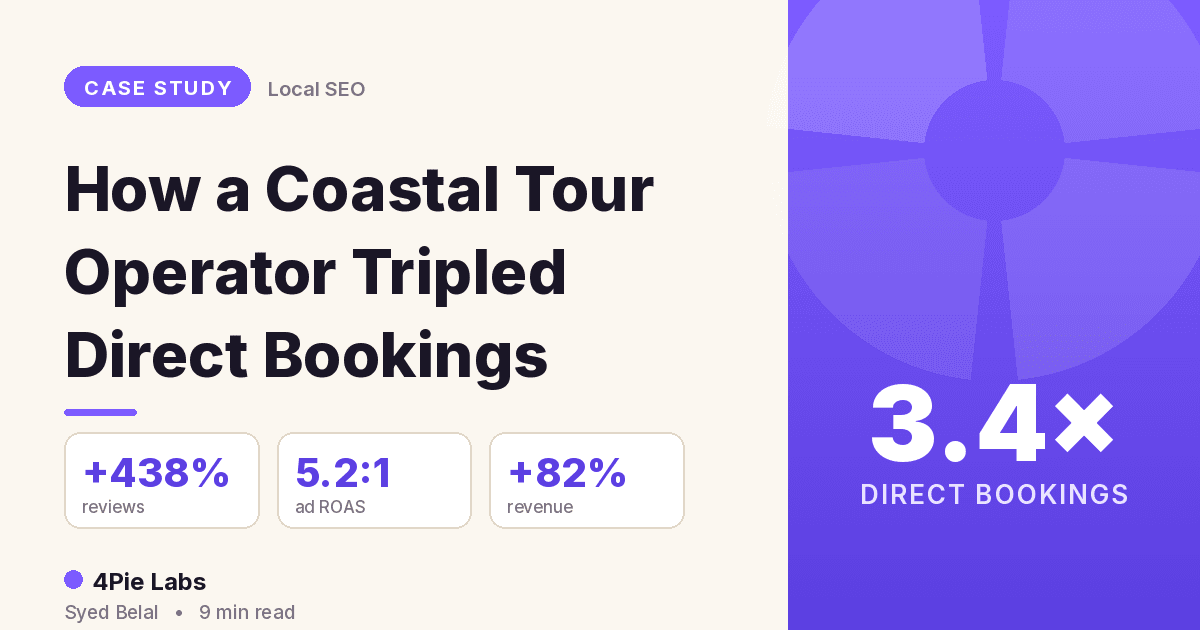
A coastal tour operator went from invisible in Google's map pack to 3.4x more direct bookings in 120 days. The reviews-and-ads playbook, by the numbers.
Note: This is a representative case study. The operator is a composite based on real engagements in the tours-and-activities space, and the figures are modeled from the cited industry benchmarks below — they're illustrative, not a single client's audited results.
A coastal tour operator can do everything right on the water and still lose the booking before the customer ever sees the boat. The whole fight now happens on a phone screen — in Google's map pack, in the reviews, in the three seconds it takes someone to decide you look trustworthy. This operator was winning on the water and losing on the screen.
Here's the short version: in 120 days, a small-group kayak and sunset-cruise operator went from buried in the map pack with 31 reviews to ranking in the local top three, tripled its direct bookings (54 to 186 a month), and lifted monthly revenue +82% — without discounting and without adding a single boat. Two levers did most of the work: a review engine and a properly run Google Ads account. Below is exactly how, with the numbers.
The starting point: great tours, invisible online
The owner thought the problem was pricing. It wasn't. The real problem was that most people searching "kayak tour" in his town never saw him at all — and the ones who did saw a thinner review profile than the two operators above him.
| Baseline (Day 0) | Value |
|---|---|
| Google reviews | 31 |
| Average rating | 4.2 stars |
| New reviews / month | ~3 |
| Monthly bookings | ~180 |
| Average booking value | ~$148 |
| Channel mix | 30% direct / 70% OTA |
| Google Ads | none (a stalled, untracked account) |
| Map-pack position (primary term) | not in top 3 |
Two numbers there should bother any operator. First, 70% of bookings came through OTAs like Viator and GetYourGuide — which means roughly 20-30% of that revenue walked straight out the door as commission. Second, 3 reviews a month is a slow trickle, and the rating sat at 4.2 while competitors hovered near 4.7-4.8. On a results page, that gap is the difference between "looks fine" and "looks like the obvious choice."
How we modeled this. Baseline: ~180 bookings/month, ~$148 average order value, 30% direct / 70% OTA, 31 reviews at 4.2 stars, no working paid search. Each change below is modeled from a named industry benchmark (cited inline) rather than asserted. Review-request automation is modeled to lift velocity into the 3-5x range; paid search is modeled at $2,500/month and a 5.2:1 return, inside the travel/hospitality range reported by WordStream/LocalIQ; direct-booking share is modeled to climb to ~58% as visibility and trust improve. All figures are illustrative.
Why reviews were the real lever
Reviews aren't a vanity metric for a local business — they're load-bearing. They do two jobs at once.
They help you get found. Review signals (count, rating, and recency) are consistently ranked among the strongest local-pack ranking factors in Whitespark's Local Search Ranking Factors study. More good, recent reviews is one of the few ranking inputs a small operator can directly influence.
And they help you get chosen. According to BrightLocal's annual Local Consumer Review Survey, the overwhelming majority of consumers read reviews before picking a local business, and star rating is the single attribute they weigh most. There's a revenue line under this too: a well-known Harvard Business School study by Michael Luca found that a one-star increase on Yelp was associated with roughly a 5-9% increase in revenue for independent businesses. Ratings move money.
So the rating gap wasn't cosmetic. It was suppressing both visibility and conversion at the same time.
Phase 1: the review engine
The fix for "3 reviews a month" is almost never "ask harder." It's "ask automatically, at the right moment, with zero friction." We built a simple, relentless system:
- A trigger, not a hope. The moment a tour was marked complete in the booking system, an automated text went out within the hour — while people were still buzzing, sunburned, and happy. Timing is most of the battle; a request sent the next afternoon converts a fraction as well.
- Text first, email backup. The SMS led with a one-tap link straight to the Google review form. A follow-up email went 24 hours later to anyone who hadn't left one.
- A human-sounding ask. Not "Please rate us." More like: "Hope you loved the sunset out there today — if you've got 20 seconds, a quick Google review genuinely helps a small local crew like ours." Specific and warm beats corporate.
- A dock-side QR code on the waiver clipboard and the dock signage, for the in-the-moment crowd.
- A response protocol. Every review — good or bad — got a reply within 24 hours. Responding signals an active, real business to both customers and Google.
The result: review velocity jumped from ~3/month to ~34/month, taking the profile from 31 reviews to 167 in four months, and the average rating climbed from 4.2 to 4.8. This isn't a magic outcome — automating the ask routinely produces a 3-5x lift in review volume, because the constraint was never that customers were unwilling. It was that no one was asking at the right time.
Phase 2: fixing the Google Business Profile
More reviews feed the map pack, but the profile itself has to be complete to rank and convert. We treated the Google Business Profile like a landing page, not a directory listing:
- Primary and secondary categories set precisely (e.g., "Kayaking instructor," "Boat tour agency," "Tour operator") instead of one vague pick.
- Real, geotagged photos of actual tours added on a regular cadence — Google rewards fresh media, and people book what they can picture themselves doing.
- Services and offerings itemized with descriptions and prices.
- Google Posts for seasonal offers and availability.
- The Q&A section seeded with the questions people actually ask (parking, kid-friendliness, what to bring) so the answers were there before someone bounced to a competitor.
This matters because local intent converts hard and fast. Think with Google has shown that a large share of "near me" and local mobile searches lead to a visit or a contact within a day. When someone is standing on the boardwalk searching "sunset kayak tour," the complete, top-ranked, 4.8-star profile wins — and the incomplete one three spots down doesn't get a look.
Phase 3: Google Ads that capture intent (not waste budget)
With organic visibility climbing, paid search was the accelerator — and the place most small operators light money on fire. The account was rebuilt around intent and tracking, not impressions:
- Conversion tracking first. Before spending a dollar, every booking was tracked back to its source. You cannot manage what you cannot measure, and "we ran ads and got busy" is not measurement.
- High-intent search terms ("book kayak tour [town]," "sunset boat cruise [town]") on phrase and exact match — not broad match torching budget on "things to do."
- Tight geo-targeting around the town and the drive-time radius tourists actually come from, plus dayparting toward booking-decision hours.
- A Performance Max campaign for the activity, fed with the new tour photos and the strongest reviews as assets.
- Ad copy that pre-sold trust: the 4.8-star rating and "locally owned small-group tours" front and center, with a clear "Book direct" path.
Modeled at $2,500/month in spend, the account returned a 5.2:1 ROAS — about $13,000/month in attributable bookings, roughly 88 bookings at the operator's average order value. That sits comfortably inside the range WordStream/LocalIQ reports for travel and hospitality search campaigns; it isn't an outlier, it's what disciplined targeting plus conversion tracking tends to produce. Crucially, the ads pushed people to book direct, not through an OTA — so the margin stayed in the business.
The results, side by side
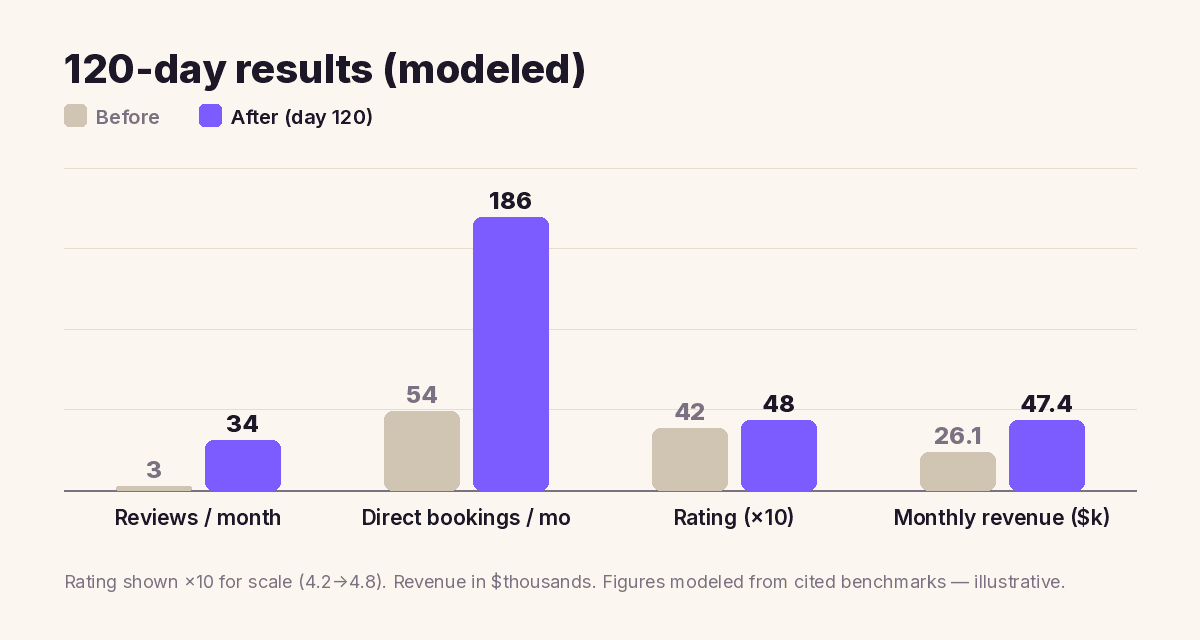
| Metric | Before | After (Day 120) | Change |
|---|---|---|---|
| Google reviews | 31 | 167 | +438% |
| Average rating | 4.2 | 4.8 | +0.6 star |
| New reviews / month | ~3 | ~34 | ~11x |
| Map-pack rank (primary term) | not top 3 | top 3 | — |
| Monthly bookings | ~180 | ~320 | +78% |
| Direct bookings / month | 54 | 186 | 3.4x |
| Direct booking share | 30% | 58% | +28 pts |
| Google Ads ROAS | n/a | 5.2:1 | — |
| Monthly revenue | ~$26.1k | ~$47.4k | +82% |
The headline isn't really the revenue number. It's the mix shift. Going from 30% to 58% direct booking means a much larger slice of every month's revenue arrives without an OTA commission attached — and the business now owns those customer relationships for next season.
Why it worked (so you can copy the mechanism)
Three forces compounded, and the order matters:
1. Reviews unlocked visibility and trust simultaneously. More recent, higher-rated reviews lifted map-pack ranking *and* made the listing the obvious click. One lever, two payoffs.
2. A complete profile converted the new visibility. Visibility you don't convert is just traffic. The optimized profile turned "found" into "booked."
3. Paid search captured the high-intent demand that was already there — and pointed it at direct booking, recovering OTA margin instead of feeding it.
None of this required a rebrand, a new website, or a discount war. It required asking for reviews at the right moment, treating the Google profile like it mattered, and spending ad budget only where intent was real and trackable.
What to steal this week
- Automate the review ask to fire within an hour of service, text-first, with a one-tap link. This single change moves the needle fastest.
- Reply to every review within a day. It's a ranking and trust signal, and it's free.
- Complete your Google Business Profile like a landing page: precise categories, fresh photos, services with prices, seeded Q&A.
- Turn on conversion tracking before you spend on ads — then start with a small budget on high-intent, exact/phrase terms in a tight radius.
- Put a "book direct" path everywhere and protect your margin from OTA commission.
If you run a tour, charter, or activity business and your phone isn't ringing the way your tours deserve, this is usually why — and it's fixable in a quarter. See how our Pipeline program builds this engine for local operators, or book a free 20-minute teardown of your Google presence and we'll show you where the bookings are leaking.
Frequently asked questions
Do online reviews really affect Google ranking?
Yes. Review count, average star rating, and how recent your reviews are all feed local-pack (map) ranking, and a higher rating also lifts click-through and on-page conversion. Reviews are one of the strongest local ranking factors you actually control.
How fast can a tour operator get more reviews?
Fast. With an automated text-and-email request sent within an hour of the tour, while the experience is still fresh, review velocity commonly rises 3-5x within the first few weeks. The bottleneck is almost always asking, not willingness.
Are Google Ads worth it for a small tour operator?
Usually yes, if you target high-intent local searches and track actual bookings. Travel and activity campaigns can return several dollars per dollar spent, but only with conversion tracking and tight geo and keyword targeting. Without tracking, you are guessing.
Why push direct bookings instead of relying on Viator or GetYourGuide?
OTAs typically take roughly 20-30% commission per booking. Shifting even part of your volume to direct booking recovers that margin, and it hands you the customer relationship, the email, and the data to remarket later.
How long before this shows up in revenue?
Review counts and ad traffic move within weeks. Map-pack ranking and direct-booking share build over roughly 60-120 days as trust and visibility compound. Treat it as a quarter-long play, not a one-week switch.